Kundali Milan · matching two charts
Kundali Milan: how the match is read
Kundali Milan compares two birth charts the way families have matched them for generations: eight kootas scored out of 36 points from the two Moons, with Mangal dosha read in both. This page explains what is counted, what the free match shows, what the ₹199 report adds and what no matching can do.
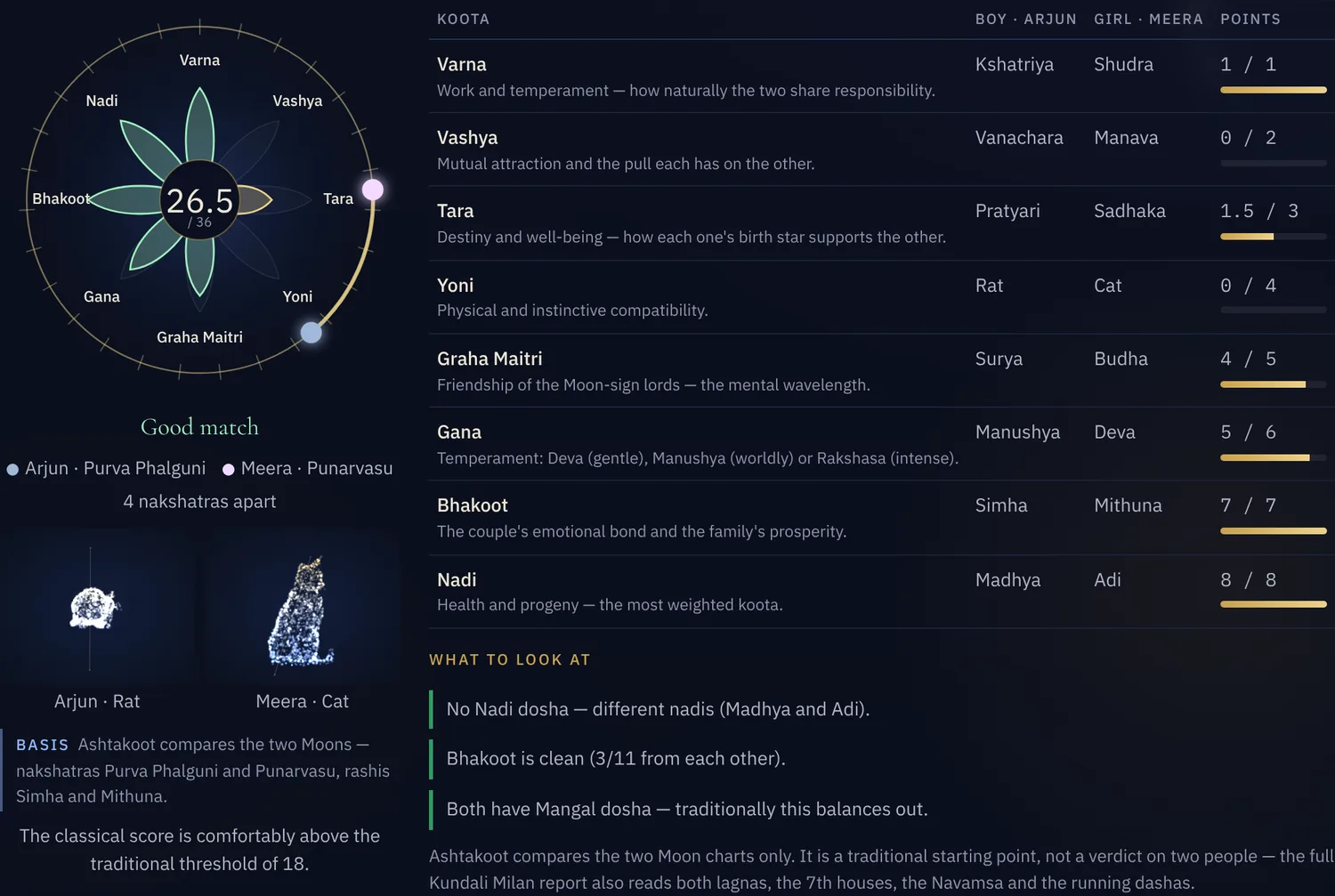
What it is
Ashtakoota, the eight-fold match, compares the nakshatra and rashi of two Moons on eight measures: Varna, Vashya, Tara, Yoni, Graha Maitri, Gana, Bhakoot and Nadi, worth 1, 2, 3, 4, 5, 6, 7 and 8 points, 36 in all. Traditional practice treats 18 points as the level at which a match is worth taking further.
It is a starting point, not a verdict on two people. The classical texts also look at both lagnas, the 7th houses, the Navamsa and the running dashas, and a good match is judged on all of them together.
How it works
- Enter the two sets of birth details in the app, or fill one with your own. Each chart is calculated sidereal with the Lahiri ayanamsa, and the second person’s details are used for the match only and are not stored.
- The match shows the eight kootas one by one with their points and a plain line for each, the animal (yoni) of each Moon, the Nadi and Bhakoot checks, and Mangal dosha in both charts with its classical cancellations.
- The Kundali Milan report (₹199, 6–8 pages) goes further: both lagnas, the 7th houses, the Navamsa, the timing for marriage in both charts and what helps the match, with the basis under every section.
What it costs
- The eight-koota match
- Free, with the WhatsApp number that unlocks your kundali.
- The full report
- ₹199 for 6–8 pages, written in about a minute and delivered as a private page.
- Reviewed by a jyotishi
- Add it to the report for ₹350 more.
- Tax
- Prices include 18% GST, and every payment gets a GST invoice.
What it never does
- Call a match “bad” or tell two people not to marry: a low score is a reason to look at the other factors, not an order.
- Predict that a marriage will fail or that anyone is in danger.
- Sell a gemstone, puja or remedy to “fix” a match.
- Judge who anyone loves or how they live: the same rules apply to every pair.
Questions people ask
What score is a good match?
Tradition treats 18 of 36 as the minimum worth considering, and higher scores as closer matches. The score is one factor: Nadi, Bhakoot and Mangal dosha are read separately, and the full report adds both lagnas, the 7th houses and the dashas.
What if both of us have Mangal dosha?
The classical texts say a partner with the same factor balances it, and several cancellations apply, such as Mangal in its own sign. The match shows what both charts actually have, and one chart can be checked on the Mangal dosha page.
Do I need the exact birth time?
The eight kootas come from the Moon, so they need only the date and place of birth and rarely depend on the exact time. If a birth was close to a nakshatra boundary the time can matter, and the report reads both lagnas only when the times are known.
Is the report a verdict on the marriage?
No. It is guidance: it explains each koota in plain words, shows what both charts say about timing, and says what helps. Jyotish describes tendencies, and no outcome is promised.
Every position on this page is calculated sidereal with the Lahiri ayanamsa from the astronomy-engine library (MIT licence). The classical texts describe tendencies; this page is for guidance and reflection, not a verdict, and no outcome is promised. How we calculate. This is the English page and the legal reference. The same page is available in Hindi. Checked October 2026.